

Phil Washington — The Accidental Transit Manager
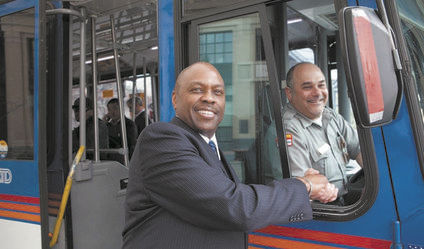
Forty years ago a 17-year-old African American youth residing in the tough Altgeld Gardens public housing project on Chicago’s Southside decided his best escape was to enlist in the United States Army. (Nearly a decade later, another young man, named Barack Obama, would arrive there as a community organizer.) Twenty-four years into his career Phil Washington had risen through the Army enlisted ranks to Command Sergeant Major, stationed at Fort Carson in Colorado Springs. Along the way, Washington picked up a college degree at Columbia College and a Master’s in Public Administration from Webster University. Growing restive, he felt it was time to take his talents into civilian life. Noting a newspaper ad for the Assistant General Manager of Administration slot at the Regional Transportation District, he applied. On his drive to Denver, he figured his interview would prove good practice for the transition he was considering. RTD’s General Manager, Cal Marsella offered him the job.
While he remained obligated to serve another year at Fort Carson, Washington felt he might be able to negotiate an earlier release. Marsella assured him that he would hold the position open. Six months later, in late 1999, Washington reported to RTD’s executive offices. Just four years into a 14 year tenure at the top of RTD, Marsella was looking for a manager who could make the buses run on time while Cal maneuvered through choppy political waters to secure public funding for what became the FasTracks transit expansion throughout the Denver metropolitan region. Washington is the first to credit Marsella for his political savvy, evidenced by success in corralling a rambunctious Board of Directors and marshaling unanimous support from the metro mayors caucus as well as the future governor.
“Politics wasn’t my bag,” Washington recalls. RTD would go to the ballot for voter approval of the light rail portion of the I-25, T-REX expansion project, lose a “Guide the Ride” transit proposal and eventually cobble together an acceptable plan with FasTracks. When Marsella departed RTD in 2009, Washington was left to implement the system’s deployment just as Colorado’s economy was crashing in response to the Great Recession.

The West Rail Line opened eight months early and well under budget. That helped, as did savings in RTD’s operational budget; but it became evident that the only chance of funding FasTracks without returning to voters for more money (a doubtful proposition) would be the negotiation of Public Private Partnerships (P3s). Washington was plowing untilled ground. While P3 agreements had been used to fund tollways, bridges and other highway projects, no one had successfully structured a P3 transit line anywhere in the country. Five FasTracks projects open for service in 2016, none structured alike, none with the same mix of public and private funds, but each is nearing completion — delivering 90 percent of the original FasTracks program nearly five years ahead of schedule. The only major project remaining is the Northwest Rail Line extension, while the U.S. 36 busway should provide substantial interim relief.
Washington’s startling success won the attention of transit leaders across the country. When Los Angeles Metro announced it had offered its General Manager’s job to Washington, there were many long faces and more than a few tears at RTD’s Blake Street offices. Washington has proven a manager who commands both the loyalty and affection of his subordinates. He took time to explain why he felt it was time to leave and turn RTD over to a manager with different skills. At the turn of the century, local papers generated a list of the 50 Colorado leaders who had exercised the most influence during the 20th century. Cal Marsella was left off that list. Recently Phil Washington made a list in 5280 Magazine of the state’s most powerful civic leaders. Fifty years hence, our children and grandchildren will be grateful for this tag team, although they may give voters credit, as Washington suggested to me, for ‘planning ahead’. He’s a man whose opinions are worth listening to:
MH: Why did you decide to leave for Los Angeles?
PW: The challenge primarily — helping to transform a region through transportation infrastructure investment. That’s what we’ve accomplished here. Transformation through transportation is what we call it. To do that again, carrying the lessons learned here was my primary motivation.
MH: Let me ask a related question: there is a theory that the cities that will be the most successful economically during the rest of this century are those willing to make investments in transit. We’ve done that. Why has RTD been so successful with the P3 model, when others, including L.A., don’t seem to be able to get anything off the ground?
PW: First there is the partnership we have been able to develop with the private sector. We’ve made it clear we are ready to do business. This is really nothing new — the transcontinental railroad received government incentives, for example. Our success with the Eagle P3 (Gold Line and Air Train) is still the only successful transit-only P3 in the country. Number two, the progressive nature of this region — the mayors, the governor, the developers — their belief that if we all put our heads together we can do great things. In my mind this can be replicated anywhere in the country when these parties come together. This region has a history of progressive thought: someone lays down the vision, someone builds the system, and then someone steps in and maintains it. That’s the natural progression of an infrastructure project.
MH: What about the role of TABOR? RTD has been somewhat protected because of voter authorizations, while CDOT has had to struggle?
PW: With the economy the way it has been, we have tried to approach financing by playing by the rules that exist. I think at some point Colorado, if it is to keep up with infrastructure investment, it will have to address the TABOR issue. When you look at more people moving to the urban core and placing more demands than the current infrastructure is designed to accommodate, at some point we have to deal with this influx — whether it is water, or sewage or transportation. With 80 percent of the world’s population expected to migrate into cities by the end of the century, our cities aren’t ready for that. It will be a tough, tough call by our elected officials, but they are going to have to deal with TABOR.
MH: How do you feel about the elected Board? Would FasTracks have been possible without them, or have they been more a hindrance than help?
PW: My view is that you deal with the hand that has been dealt. RTD is one of only three elected Boards in the country — and there is a need for constant education. I will say that RTD Boards, both past and present, have proven an integral part of what we’ve done. Ultimately, they are the policy makers, while I implement that policy. I think again we educate, we provide recommendations — we present the Board with sound policy recommendations, and they decide what they want to do with that policy. What we present to them will make sense. The Southeast extension is allowing us to match federal money with a 35 percent contribution from local governments. That’s good public policy.
MH: We will soon have a robust transit infrastructure for Denver Metro. We will miss an opportunity if we don’t figure out how to provide comparable service up and down I-25 and out along I-70. Are we any closer to that?
PW: My thought is a couple of things, and I’ve proposed them in public venues. In 2016, with the opening of five transit lines, we are going to enjoy a momentum that is unprecedented in this region. Voters don’t distinguish well between RTD and CDOT. The state should take advantage of our momentum — 2016 would be the best year — build on our openings to propose something greater. I would like to see rail from one end of the state to the other. I-70 West, I think if we show the benefit, we can do it. I mean show the benefit to all parts of the population — the prime contractors, to minority communities, to suppliers. I think Colorado is ready to approve something eye popping. It will take some great leadership, some real political champions.
MH: What kind of leadership will RTD require going forward? And what is your personal management philosophy?
PW: We need to maintain what we’ve built. There has to be asset management that keeps our system in good operating condition. We need to avoid the kind of neglect that we’ve seen in many large Eastern systems — New York, Boston, Washington. We’ve developed a schedule of predictive maintenance that should be tied to RTD’s procurement decisions. Those are my words of wisdom to those who will manage the system. You have to take care of your people, support them, and provide them with career opportunities and freedom to make decisions — then stand behind them even when they make a mistake. It’s a matter of trust and results — one fosters the other.
Miller Hudson is a public affairs consultant. He can be reached at mnhwriter@msn.com.

Suddenly, Colorado has a private school choice program │ Vince Bzdek
Vince Bzdek
vince.bzdek@gazette.com
Updated 2 hours ago
By Vince Bzdek When I was a kid going to St. John’s Catholic grade school in Denver, I remember asking my mom if she and dad minded paying taxes for public schools since all her kids attended Catholic ones. We...

Tyson’s beef plant closure in Nebraska to impact town, ranchers nationwide | OUT WEST ROUNDUP
Ernest Luning
ernest.luning@coloradopolitics.com
Updated 4 days ago
NEBRASKA Beef plant’s closure could ripple OMAHA — Tyson Foods’ decision to close a beef plant that employs nearly one third of residents of Lexington, Nebraska, could devastate the small city and undermine the profits of ranchers nationwide. Closing a...

Calendar Dec. 15-21
Rachael Wright
rachael.wright@coloradopolitics.com
Updated 4 days ago
CoPo’s weekly political calendar will help you find political and public-policy events throughout Colorado. It includes candidate and issue campaign events, public policy meetings, court hearings, state and local party conventions, assemblies, debates, rallies, parades, speaking engagements, traveling dignitary appearances,...
Denver Mayor Peña makes unexpected announcement | A LOOK BACK
Rachael Wright
rachael.wright@coloradopolitics.com
Updated 4 days ago
Thirty-Five Years Ago This Week: Denver Mayor Federico Peña announced personal news that caught many of his supporters and Denver residents who paid close attention to politics off guard. Just two weeks prior on Nov. 16, 1990, The Colorado Statesman...

Julie Gonzales’s long but not impossible odds | SONDERMANN
Eric Sondermann
eric-sondermann@coloradopolitics.com
Updated 4 days ago
Allow me to start with a flashback. It was Thanksgiving 2024, just over 12 months back. For the first time, our son Clarke hosted the family Thanksgiving near New York City. It is a sign of our aging when the...

Performers announced for 14th Klezfest | NONPROFIT REGISTER
Thelma Grimes
thelma.grimes@coloradopolitics.com
Updated 2 days ago
MIZEL MUSEUM JCC DENVER Denver News: Klezfest 2025, which takes place Dec. 20, will feature performances by a host of popular Jewish entertainers: Rabbi Joe Black and Steve Brodsky; Hal Aqua & The Lost Tribe; Mishmish and Gora Gora Orkestar. Rabbi Black is a pioneer of contemporary Jewish music and has...

Colorado commission makes new access-to-justice recommendations after renewed listening tour
Michael Karlik
michael.karlik@coloradopolitics.com
Updated 1 day ago
Adding judges to handle caseloads. Expanding authority for paraprofessionals in civil cases. Allowing self-represented litigants to file electronically. Making the judiciary’s website user-friendly. Those were among the recommendations advanced by the Colorado Access to Justice Commission in a report released Friday,...

Trump targets Colorado AI law with executive order, setting stage for legal fight
Marianne Goodland
marianne.goodland@coloradopolitics.com
Updated 2 days ago
Colorado’s 2024 effort to regulate artificial intelligence is facing a direct challenge from the Trump administration. President Donald Trump signed an executive order on Thursday to block states from enforcing their own AI laws. Trump also announced the creation of...
Colorado residents face high energy bills after regulators turn away from natural gas, experts say
Mark Samuelson Special to The Denver Gazette
mark.samuelson@denvergazette.com
Updated 2 days ago
Colorado residents could be paying a lot more for home energy, following the state’s decision last week to turn away from natural gas as a home cooking and heating fuel, experts said. Some 1.9 million Colorado households warm their homes...
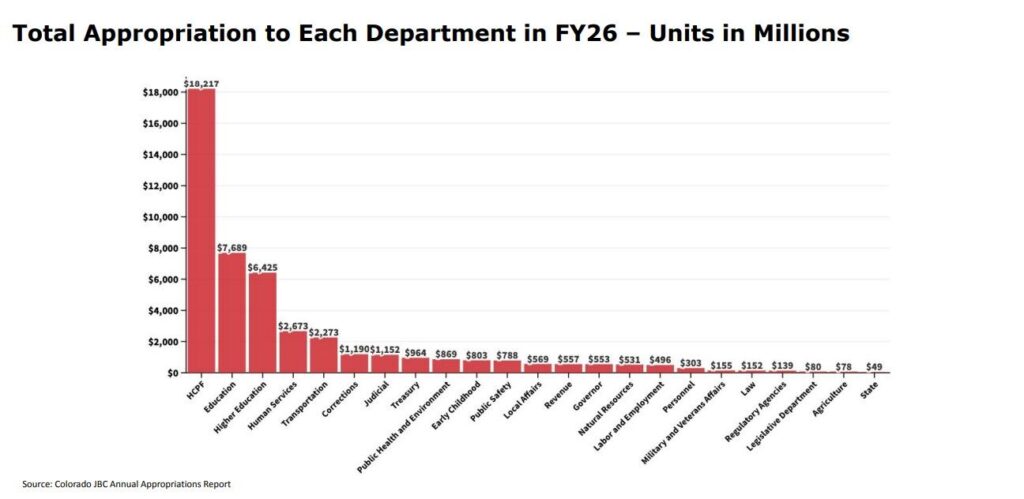
Colorado’s government spending has outpaced inflation, analysis finds
Marissa Ventrelli
marissa.ventrelli@coloradopolitics.com
Updated 2 days ago
Colorado’s per-person spending has increased by 31% over the last two decades despite slowed population growth, according to a new analysis by the Common Sense Institute. The annual report compares state spending by department over the last 20 years, tracking...
PREV
PREVIOUS

Budget heading back to JBC
The House finished its work on the 2015-16 budget Thursday, returning it to the Joint Budget Committee to work out differences with the Senate version. But last-minute drama could have sent the budget back $20 million out of balance. The annual budget bill passed on a 45-20 vote Thursday morning. Eleven Republicans voted for the […]

Log Cabin Republicans disinvited from Western Conservative Summit
The organizers of this year’s Western Conservative Summit — billed as “the premiere summer destination for Americans who still believe in freedom, family, faith, and the future” — this week told a Republican organization devoted to advocating for gays and lesbians that it can’t formally participate in the June conference in Denver. Former Senate President […]