

Healthcare Freefall: Longer drives, fewer options for maternity care in Colorado

Editor’s Note: Colorado’s healthcare system is entering a period of accelerating instability — a “tsunami,” as multiple leaders describe it — driven by collapsing hospital finances, shrinking Medicaid reimbursements, disappearing services and a political fight over who is responsible for this unraveling. Healthcare Freefall is a multipart series examining how Colorado arrived at this moment, what H.R. 1 will do next and why communities across the state are bracing for deeper shocks.
Across rural Colorado, hospitals are making choices that once seemed unimaginable — closing labor and delivery units, scaling back core services and questioning whether they can continue offering care their communities have depended on for generations.
The decisions stem from a worsening financial crisis in rural healthcare, where shrinking margins, aging populations, difficulty in recruiting a workforce and increasingly unfavorable payer mixes are forcing health leaders to weigh survival against service.
Delta Health in Delta County illustrates that shift.
The hospital closed its labor and delivery unit last November, eliminating the only birthing center for a region of 32,000 people. The unit had delivered about 120 babies a year — “one every three days,” CEO Nick Colleran said — but it was losing more than a million dollars annually.
The hospital ended 2024 with a negative 9% margin.
“Those are hard decisions you have to make when you’re living off negative margins,” Colleran said.
Staffing pressures compound the financial strain. Essey Yirdaw, vice president of data programs and health outcomes at the Colorado Hospital Association, said rural hospitals face unique challenges keeping obstetric units open.
“Labor and delivery is a 24/7 service,” she said. “You cannot close your OB department on weekends. You need surgeons, anesthesiologists, nurse midwives — and it’s hard to recruit and retain them in rural communities.”
Many rural hospitals, she said, take pride in offering local maternity care.
“They really have a sense of pride in knowing that they can give birth locally and that their family medicine physicians know them,” she said.
But, she added, declining birth volumes make it harder to maintain clinical competency.
The growing distance to care — literally
Pregnant women in much of Colorado travel long distances for maternity services.
Yirdaw said roughly half the state now qualifies as an obstetric “desert.” Many patients, she said, are driving more than an hour or 60 miles to reach care.
Her team built a statewide maternal health dashboard to track severe maternal morbidity and travel patterns. The goal, she said, is to give communities a clearer picture of what happens after childbirth and to share the data the association has collected.
The trend is perplexing: As more rural hospitals close their labor and delivery units, travel times rise.
“I don’t anticipate the average going down,” she said. “If anything, it will go up.”
That pattern is already visible in Delta County, where women now drive 35 minutes to Montrose or more than an hour from the county’s rural areas to reach the nearest hospital offering obstetric care.
Delta Health is not an outlier.
Rural hospitals across Colorado are cutting maternity services because of low birth volumes, high staffing costs and the challenge of maintaining required nurse and physician coverage.
“Just because we had 120 births, we still have to have two nurses on,” Colleran said. “You don’t have those economies of scale.”
State Sen. Dylan Roberts said closures are becoming routine across District 8, which spans parts of Clear Creek, Eagle, Garfield, Gilpin, Grand, Jackson, Moffat, Rio Blanco, Routt and Summit counties.
“The hospital in Craig had to close their maternal care services,” he said. “Now, if you’re pregnant, you have to go to Steamboat or Grand Junction.”
Other regions are seeing similar losses.
La Junta has shut down its maternity unit, adding to the number of Colorado communities without local obstetric care — a measure where the state already falls short of national averages.
The national picture, however, reflects the same trajectory.
In 2022, as worries about labor and delivery access intensified, the March of Dimes released “Nowhere to Go: Maternity Care Deserts,” documenting the nationwide decline in maternity services and providing both national and state level analyses.
With an estimated 3.5 million births annually, the organization estimates that more than two million women of childbearing age live in maternity care deserts — areas without birthing facilities or maternity care providers.
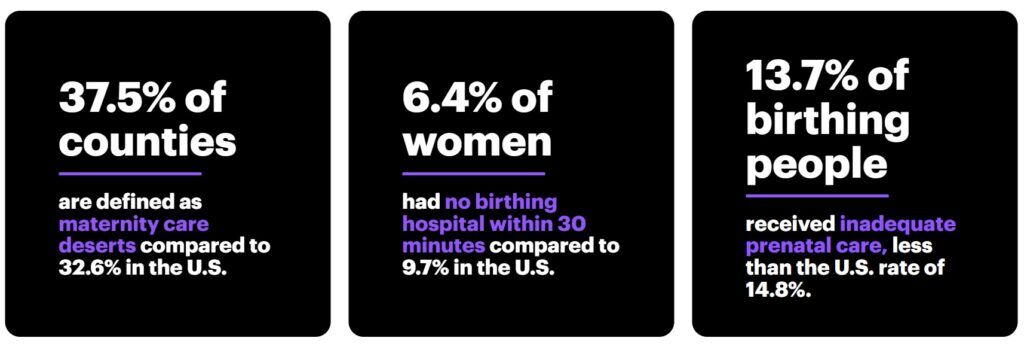
Colorado ranks 21st in the nation in the most recent 2024 March of Dimes data: About 37.5% of the state’s 64 counties are considered maternity care deserts, compared with the national average of 32.6%.
The report also found that 6.5% of Colorado women had no birthing hospital within 30 minutes, slightly better than the national figure of 9.7%. Also, in Colorado, 13.7% of women giving birth received no or inadequate prenatal care, compared with 14.8% nationally.
Public health pressures deepen strain
Tom Rennell, senior vice president of financial policy at the Colorado Hospital Association, said rural hospital finances are deteriorating quickly.
“Eighty‑four percent now have an unsustainable margin,” he said.
He pointed to a payer mix that leaves rural facilities at a disadvantage. Public programs, such as Medicare and Medicaid, make up a larger share of reimbursement in rural areas, yet neither covers the full cost of care. At the same time, many patients carry high‑deductible commercial plans that leave them functionally paying out of pocket.
“You can have a lot more concentration of public payers,” he said. “And many people technically have insurance, but they have high‑deductible plans, which functionally makes them a self‑pay patient.”
For obstetric units, the math is even harder.
Yirdaw of the Colorado Hospital Association said Medicaid underreimbursement is especially damaging because nearly half of rural OB patients rely on Medicaid. Maintaining 24/7 staffing — nurses, physicians and on‑call coverage — becomes difficult to sustain when reimbursement falls short.
In 2024, Medicaid paid for 34.9% of Colorado live births, according to the March of Dimes. Hospitals now receive about 67 cents for every dollar spent caring for Medicaid patients, down from 80 cents five years ago and 85 cents a decade ago.
Medicaid coverage is at the front of Colorado’s — and the country’s — healthcare debate. Many view it as a necessary safety net, providing care to low-income residents who otherwise cannot get insurance in the private marketplace. Without Medicaid, the argument goes, they will end up in emergency rooms, costing more, not to mention the fiscal, mental and physical toll of not affording routine care.
Others argue that the program is bloated, covering many adult, able-bodied residents who should be working and getting their coverage via their employment. That bloat means it is no longer able to actually care for the most vulnerable residents, such as people with disabilities, who the program was intended to serve to begin with. In Colorado, Medicaid is the single biggest driver of the increases in state spending.
Colorado does not track charitable birth cases specifically, but the Common Sense Institute estimated that about 10.1% of reproductive‑age women in the state lack health insurance, leaving some to rely on emergency services or hospital discount programs.
The Common Sense Institute said hospitals provide hundreds of millions of dollars in charity care each year under Colorado’s Discounted Care framework for patients earning under 250% of the federal poverty level, though they do not publish per‑procedure estimates for birth‑related charity write‑offs.
“In a state as economically healthy as Colorado, it’s not acceptable that we have these maternal care deserts. But I don’t fault these hospitals. That’s what they have to do to not completely close their doors.”
Colorado Sen. Dylan Roberts
Yirdaw said rural hospitals are trying to innovate through collaboration.
“Smaller hospitals are establishing relationships with larger hospitals to share information and clinical expertise,” she said. “They want to keep care local whenever possible.”
But she said the system is fragile.
“Access, affordability and the ability to see your doctor in the right setting — that’s what it all boils down to,” she said. “And right now, all of those are at risk.”
For rural hospitals, the combination of Medicaid cuts, insurer denials, staffing shortages and service closures is creating a crisis that compounds each year.
“In a state as economically healthy as Colorado, it’s not acceptable that we have these maternal care deserts,” Roberts said. “But I don’t fault these hospitals. That’s what they have to do to not completely close their doors.”
Read more from the Healthcare freefall series:
Longer drives, fewer options for maternity care in Colorado
Telluride mother’s roadside birth underscores shrinking access to OB care in Colorado
Breast cancer survivor shares strain of rural treatment travel
Once built on federal investment, rural hospitals today fight to survive
Subsidy cuts, insurance gaps reshape how Coloradans will seek care


Trump reaches deal to halt tariffs on beef for 90 days in bid to lower prices
Rena Rowe
rena.rowe@washingtonexaminer.com
Updated 35 minutes ago
President Donald Trump announced Friday that he had reached a deal to temporarily ease tariffs on beef imports, saying the move would help lower prices for families as the United States faces a severe cattle shortage and record-high beef prices....

Budget red ink threatens to spike inflation and unemployment
Zach Halaschak
zach-halaschak@coloradopolitics.com
Updated 41 minutes ago
The ticking time bomb that is the national debt just crossed the $40 trillion mark and could spark a fiscal crisis that could throw the economy into disarray, spiking unemployment and exploding inflation. Republicans and some centrist Democrats have long...

Aurora grapples with affordable housing needs, deficits
Kyla Pearce
kyla.pearce@gazette.com
Updated 2 days ago
Aurora is grappling with affordable housing needs as demand for project funding increases and the state cuts grant money. Currently, the city needs about 12,000 affordable housing units, Martin Petrov at Aurora Housing Authority told members of the Housing, Neighborhood...

Douglas County unveils plan to cut red tape, speed business approvals
Nicholas Fogleman
nicholas.fogleman@denvergazette.com
Updated 2 days ago
Douglas County officials on Monday unveiled a Red Tape Reduction Action Plan aimed at streamlining permitting and development reviews to position the county as “the best place in America to invest.” The plan, developed through a partnership between the Douglas...

Celebratory spirit isn’t dampened as rain forces a garden party to move indoors | NONPROFIT REGISTER
Joanne Davidson Special to Colorado Politics
joanne-davidson-special-to-colorado-politics@coloradopolitics.com
Updated 3 days ago
WARREN VILLAGE Denver News: The popularity of the Warren Village Summer Garden Party can without a doubt be credited to this: The chance to enjoy delicious food and refreshing beverages in the splendor of Dr. Jody Mathie’s exquisitely landscaped backyard. ...

Second affordable housing project on church land opens in Colorado Springs
DEBBIE KELLEY
debbie-kelley@coloradopolitics.com
Updated 3 days ago
Greccio Housing doesn’t just do business deals. The nonprofit residential developer and property manager aligns its projects with a mission of providing stable, safe and affordable housing that helps struggling residents achieve stability, according to Executive Director Lee Patke. The...

‘Art of Hope’ celebration will mark TGP’s 40th anniversary | NONPROFIT REGISTER
Joanne Davidson
joanne-davidson@coloradopolitics.com
Updated 4 days ago
THE GATHERING PLACE Denver News: Forty years ago, two University of Denver social work students saw a need that couldn’t be ignored: Women and children experiencing homelessness had to exit overnight shelters seemingly at the crack of dawn, leaving them with nowhere safe to go during...

French court blocks Macron’s social media ban for children under 15
Emily Hallas
emily-hallas@coloradopolitics.com
Updated 7 days ago
France’s top court struck down on Friday a law championed by President Emmanuel Macron that would have made it illegal for children to have social media accounts. The law, approved by lawmakers in July, was set to take effect at...

Ikon Pass company cuts jobs in Denver and beyond amid several changes
Bernadette Berdychowski
bernadette.berdychowski@denvergazette.com
Updated 7 days ago
As the ski resort company behind the Ikon Pass and the operator of Steamboat Springs, Arapahoe Basin and Winter Park Resort is going through a phase of changes, the Denver-based company is now cutting jobs. Alterra Mountain Co. has laid...

After a snowless winter, agents say summer is luring second-home buyers to the mountains
Mark Samuelson Special to The Denver Gazette
mark.samuelson@denvergazette.com
Updated 1 week ago
Last winter was a terrible growing season in Grand County for what arguably is its most important crop: snow. The county 60 miles west of Denver over the top of Berthoud Pass saw a record-low snowpack — poor enough that...
PREV
PREVIOUS

Judge grants partial injunction to GEO in fight against state health inspection law
A judge ruled Thursday that The GEO Group does not have to follow parts of a new state law requiring more frequent health and safety inspections at the U.S. Immigration and Customs Enforcement processing center in Aurora. Under the order of District Judge Daniel Domenico, GEO does not have to adhere to a section of […]

Healthcare freefall: Breast cancer survivor shares strain of rural treatment travel
Editor’s Note: Colorado’s healthcare system is entering a period of accelerating instability — a “tsunami,” as multiple leaders describe it — driven by collapsing hospital finances, shrinking Medicaid reimbursements, disappearing services and a political fight over who is responsible for this unraveling. Healthcare Freefall is a multipart series examining how Colorado arrived at this moment, […]