

Colorado Springs may be sued for faulty intersection, state Supreme Court rules

The Colorado Supreme Court decided last month that Colorado Springs can be sued over a collision that occurred as a result of traffic lights that were functioning normally in one direction, but were inoperative in the perpendicular direction.
The question for the Supreme Court was whether the traffic arrangement provided “conflicting” signals to plaintiff Bernard E. Sandoval and the driver he collided with. Although the Court of Appeals believed there was no conflict, the justices disagreed.
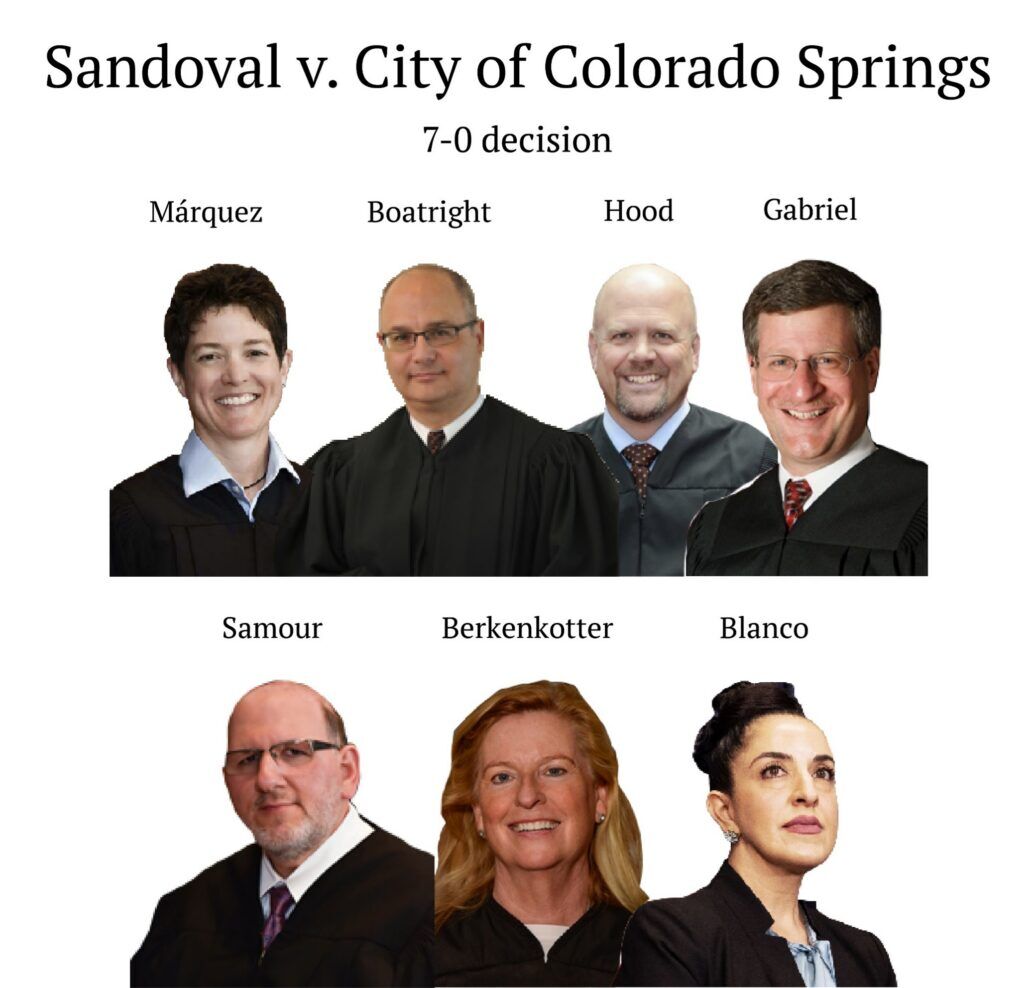
“Realistically, no municipality would design an intersection with a traffic light only operating one way while the cross traffic adhered to a stop sign because of the practical ramifications. This would create confusion for drivers,” wrote Justice Brian D. Boatright in the May 26 opinion.
Construction was occurring at the intersection of South Tejon Street and East Costilla Street in August 2019 when Sandoval drove up to the intersection and faced an unilluminated light. Treating the intersection as a four-way stop, he proceeded and was hit by a driver traveling in the perpendicular direction whose light was green. He then sued.
The Colorado Governmental Immunity Act generally shields public entities from lawsuits over injuries they cause. There is an exception, however, if the government fails to address “a traffic control signal on which conflicting directions are displayed.”
District Court Judge Amanda Philipps declined to dismiss the lawsuit, finding the conflicting-directions exception applied. But on appeal, the city maintained the signals did not conflict because it was possible for Sandoval to treat his light as a stop sign and for the other driver to proceed on green without inevitably colliding.
A three-judge Court of Appeals panel agreed. Under Colorado’s traffic laws, explained Judge Ted C. Tow III, the driver with a green light should proceed normally and the driver facing an inoperative light has the obligation to proceed only when the intersection is clear.
Because the drivers who collided “could have followed these directions simultaneously without issue, the signals were not incompatible,” he wrote.

The Supreme Court, however, was concerned about the panel’s focus on the driver and not the light.
“We have to ask ourselves, what does that dark, unilluminated signal mean?” said W. Erik Lamphere of the City Attorney’s Office during oral arguments. “And it doesn’t mean to proceed through that intersection without regard.”
“I have trouble seeing why an objectively reasonable person would not have treated that as a four-way stop when you’re there in the moment,” countered Justice Richard L. Gabriel.
Boatright asked Lamphere whether it constituted a dangerous condition for one set of lights to be dark while the perpendicular lights were operational. No, not inherently, said Lamphere.
“Do you think if that was the light situation, the city would be like, ‘We’ll get to that in a couple days, it’s no big deal?’” Boatright asked. “Or would they be like, ‘We need to get out there because that’s a dangerous situation’?”
“It is an unusual situation,” said Lamphere.
Ultimately, the Supreme Court reinstated Sandoval’s lawsuit.
“Each day, motorists depend on predictability to remain safe on the road. For example, we expect that other cars will stop at red lights. And we plan accordingly. Predicting the actions of other drivers stems from our social contract that we all subscribe to on the road to keep ourselves and others safe,” wrote Boatright. “However, the scenario presented here removed predictability at the intersection. With the light malfunctioning in one direction, it must have become very difficult for drivers, like Sandoval, to predict the conduct of other drivers in the cross-traffic.”
He added that, contrary to the Court of Appeals’ view, Sandoval could not have complied with traffic laws “because no such law envisions this vexing situation.”
Therefore, the signals were inherently conflicting and the city was not entitled to immunity.
The case is Sandoval v. City of Colorado Springs.

Colorado justices say insurers may access policyholders’ medical info in denied-benefits litigation
Michael Karlik
michael.karlik@coloradopolitics.com
Updated 20 hours ago
The Colorado Supreme Court declined on Monday to expand its narrow prohibition on insurance companies accessing policyholders’ medical information, clarifying that a dispute over an insurer’s bad-faith decision to deny benefits is the only situation where a company is limited...
Colorado Supreme Court declines to loosen requirements for insurance company defendants
Michael Karlik
michael.karlik@coloradopolitics.com
Updated 2 days ago
The Colorado Supreme Court declined last week to reconsider its longstanding expectations for insurance company defendants, and agreed that an insurer failed to properly raise its defenses against a policyholder’s breach-of-contract lawsuit. When an insured driver has an accident with...

Teen defendant properly transferred from youth detention to jail, Colorado justices conclude
Michael Karlik
michael.karlik@coloradopolitics.com
Updated 19 hours ago
Colorado law required the transfer of a teenage murder suspect from youth detention to the county jail when he turned 18, the state Supreme Court ruled last week. Prosecutors have accused Issac James Lawrence of killing a younger boy and attempting to...
Divided Colorado Supreme Court finds parental anonymity in ‘safe haven’ law
Michael Karlik
michael.karlik@coloradopolitics.com
Updated 2 days ago
Parents who surrender their newborns under Colorado’s “safe haven” law are entitled to anonymity and confidentiality in any subsequent adoptive proceedings involving the child, the state Supreme Court ruled on June 8. Colorado’s law, like its counterparts across the country,...
Safe2Tell tip, corroborated details provided grounds to search backpack, Colorado justices rule
Michael Karlik
michael.karlik@coloradopolitics.com
Updated 2 days ago
The Colorado Supreme Court decided this month that a tip submitted through the state’s confidential school safety system, plus a Douglas County administrator’s corroboration of some details, provided reasonable suspicion to search a student’s backpack for drugs. Someone submitted a...
Appeals court finds opening in Colorado Supreme Court’s framework for child neglect cases
Michael Karlik
michael.karlik@coloradopolitics.com
Updated 4 days ago
Colorado’s second-highest court squeezed through an opening last week in a controversial state Supreme Court decision from 2025, concluding that the justices had not prohibited a child’s legal representative from being the one to request termination of parental rights in...
Colorado Supreme Court upholds police search of car based on arm movements
Michael Karlik
michael.karlik@coloradopolitics.com
Updated 2 days ago
The Colorado Supreme Court decided last week that Denver officers’ search of a vehicle was constitutional, based on their perception of the occupants’ arm movements that a trial judge found to not be credible. Officers Keegan Grubb and Richard Eberharter...
10th Circuit tosses Pueblo County sheriff defendants’ appeal in fatal shooting lawsuit
Michael Karlik
michael.karlik@coloradopolitics.com
Updated 2 days ago
The Denver-based federal appeals court rejected an attempt from Pueblo County sheriff’s employees on Wednesday to rely on their own version of the facts to escape liability for fatally shooting an unarmed man outside a middle school. A trial judge...
Colorado justices uphold strict interpretation of consumer protection law against debt collector
Michael Karlik
michael.karlik@coloradopolitics.com
Updated 2 days ago
The Colorado Supreme Court concluded last month that a debt collector failed to comply with state law by suing a woman for an unpaid credit card debt without documentation that it owned her account. Portfolio Recovery Associates LLC filed a...
Colorado justices say judges can nearly eliminate parenting time without it being a ‘restriction’
Michael Karlik
michael.karlik@coloradopolitics.com
Updated 2 days ago
The Colorado Supreme Court concluded last month that judges can reduce the number of days a parent spends with their child post-divorce to just above zero without it rising to the level of a “restriction” that requires more rigorous justification...
PREV
PREVIOUS
Internal appeals of parole revocation must come before judicial review, Colorado justices conclude
The Colorado Supreme Court ruled last month that criminal defendants whose parole is revoked must appeal the decision internally to the state’s parole board before seeking review by a judge. The process for returning someone to incarceration for violating the conditions of their parole first entails a hearing by one member of the Colorado State […]

Cigna to pull out of individual health market, affecting thousands in Colorado
Another firm is withdrawing from the individual health insurance market, including for Colorado, effective Jan. 1, 2027. The move by Cigna Healthcare is part of the company’s overall plan to withdraw entirely from the Affordable Care Act market. It will impact individual health plans for 369,000 members in 11 states, according to a company announcement […]