

Judge agrees security guards could block woman from entering courthouse for failing to answer question
Security guards acted within their authority by requiring a woman to disclose which courtroom she was going to as a condition of entering the federal courthouse in Denver, a judge has ruled.
Tiffany Grays missed a court hearing in her civil case last fall because two court security officers, identified as CSOs Lee and Garcia, would not let her through without answering a “courtesy” question about her destination in the courthouse. Garcia then told the magistrate judge overseeing the hearing that Grays was belligerent, prompting a rescheduling of the proceeding.
Grays, who is representing herself, alleged that the denial of access infringed upon her rights to free speech and due process. However, U.S. District Court Judge William J. Martínez flatly rejected those claims in an order last week.
“There is simply no precedent to support Plaintiff’s position that the First Amendment prohibits a government officer from requiring a person entering a government building to answer basic questions about her business there,” Martínez wrote on April 21.
Darold Killmer, a civil rights attorney with Killmer, Lane & Newman, believed the judge decided correctly, noting that security measures placed on government buildings do not rise to the level of a constitutional violation.
“The First Amendment allows for reasonable time, place and manner restrictions on a person’s right to express themself or to access public facilities,” he said. “In this day and age, we have all been subjected to minimally intrusive inconveniences, such as walking through metal detectors, providing identification or other information prior to accessing facilities, and the like. I do not believe Ms. Grays’ constitutional rights were violated.”
Grays initiated her federal lawsuit against student loan servicer Navient in early 2020, alleging that the company incorrectly reported her payments and damaged her credit, affecting her ability to obtain auto loans or credit cards.
On Oct. 27, 2021, Grays arrived at the Byron G. Rogers U.S. Courthouse in downtown Denver for a hearing in the case. According to Grays, as she was proceeding through security, Lee asked her “What/why are you here?”
“I’m here for court,” Grays replied. When Lee reportedly asked which courtroom Grays was going to, she replied that she did not have to tell him.
In a video that Grays began recording, she asked Lee which policy or rule required her to disclose her destination. She told Lee to “get your supervisor.”
“The only thing I’m asking you -” Lee began to say.
“I don’t have to tell you that. I’m in the right courthouse,” Grays retorted.
As Grays was waiting for a supervisor, she repeatedly asked another person in the lobby why they were not wearing a face mask properly. When Garcia arrived, he acknowledged to Grays that there was no rule requiring her to disclose her courtroom, but “we do it out of courtesy.”
“Uh-oh, so you’re making up your own rules and you’re preventing me from going to court,” Grays interrupted. “That is a violation of my constitutional rights to go to court.”
Garcia offered to explain why security officers ask for visitors’ destinations, but Grays said she did not want to hear it. She maintained there was no authority to ask that question.
“Let’s not play games here,” she said. She asked for Garcia’s last name, then his first name. He responded, apparently in jest, that there was “no rule or law that says I gotta tell you.” Grays laughed at the response.
Shortly after the encounter, Grays emailed U.S. Magistrate Judge S. Kato Crews, who was conducting the hearing in her case, saying she was “being denied access” and asked to have the hearing over the phone. During a brief, three-minute proceeding in his courtroom, Crews announced that Grays was not present because Garcia had informed him that she “became belligerent.”
Crews issued an order that same day explaining that the security guards often ask visitors where they are going because the presence of multiple federal buildings adjacent to the Rogers courthouse can confuse people.
“This is a federal courthouse, not a department store,” Crews wrote. “Ms. Grays is warned that she is required by the Local Rules of Practice, and is ordered by this Court, to comply with all customary requests, inquiries, and procedures of the CSOs anytime she is required to access the courthouse for settings where she is required to appear in person.”
Grays filed several requests to the court, asking for all future hearings to be by phone to limit her “exposure to PTSD” and to be excused from answering future “courtesy questions.” She also submitted a letter pursuant to the Freedom of Information Act asking for video and audio from the courthouse lobby on the day of the encounter.
Martínez, the district court judge assigned to her case, dispensed with all of her concerns, writing that there was no impending hearing requiring her to appear in person and that the court was exempt from FOIA requests. The judge also quoted from Local Rule 83.2(b), which requires anyone seeking to enter a court building to “provide identification or information” upon request of a court security officer.
“The Court agrees with Judge Crews that the CSO’s question about what courtroom she was planning to attend falls within the scope of the questions that anyone seeking entry to any court building must answer if asked,” Martínez concluded. “Therefore, Judge Crews acted properly by ordering Plaintiff to comply with such requests in the future.”
Grays disputed that she was belligerent and told Colorado Politics she intended to pursue the alleged infringement on her rights to the appellate courts.
“I don’t have to answer courtesy questions to get to court,” she said.
The clerk of the U.S. District Court said that neither he nor the U.S. Marshals Service tracked how many people had been prevented from entering Colorado’s district courthouses in the past year.


U.S. Supreme Court will hear challenge from Colorado Catholic preschools on state funding exclusion
Lindsay Whitehurst
lindsay.whitehurst@associatedpress.com
Updated 9 hours ago
WASHINGTON (AP) — The Supreme Court will hear from Catholic preschools that say Colorado violated their religious rights by excluding them from a state-funded “universal” pre-kindergarten program over their admission policies. The court agreed on Monday to take up the...
DougCo commissioners challenging open meetings violation
Nicholas Fogleman
nicholas.fogleman@denvergazette.com
Updated 11 hours ago
The Douglas County Board of Commissioners is challenging a recent court decision that found the board violated Colorado Open Meetings Law. County commissioners filed a petition Thursday seeking a rehearing from the Colorado Court of Appeals. On April 2, the...
Colorado justices, lawyers speak with rural students through outreach program
Michael Karlik
michael.karlik@coloradopolitics.com
Updated 3 days ago
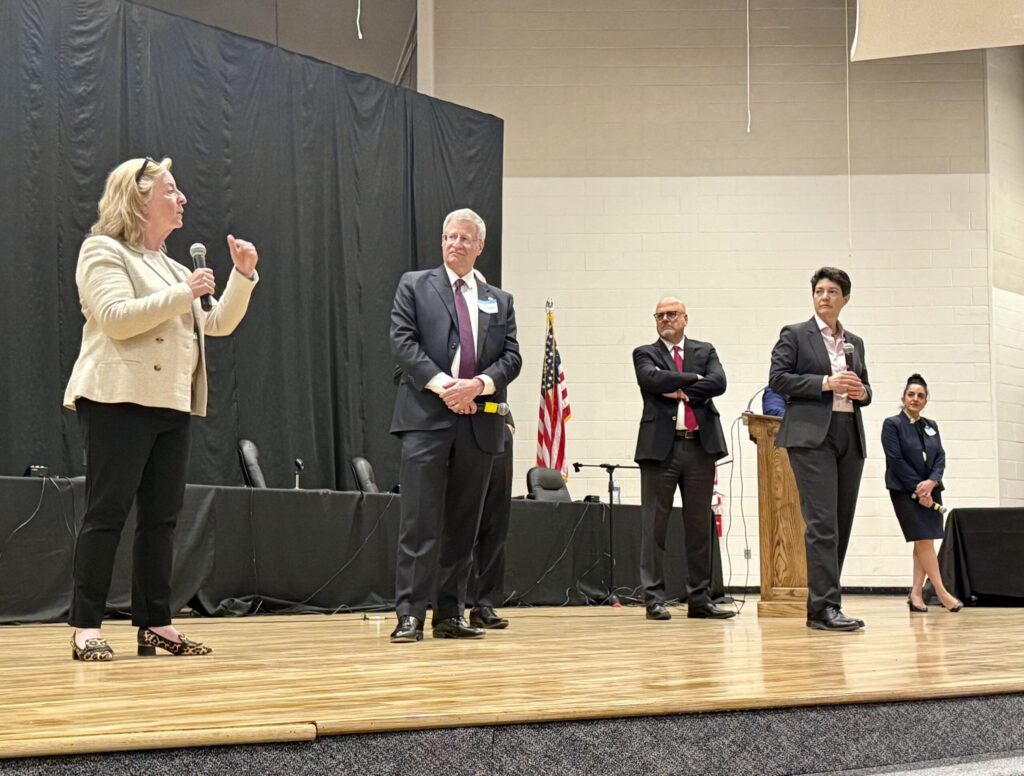
Members of the Colorado Supreme Court appeared before students from eight rural schools on Thursday to hear a pair of cases, field questions, and mark the first time the state’s newest justice participated in the long-running program. “I had such...
Colorado justices skeptical of snowboarder’s bid to revive injury lawsuit after signing new waiver
Michael Karlik
michael.karlik@coloradopolitics.com
Updated 3 days ago
The Colorado Supreme Court seemed to agree on Thursday that a plaintiff is not entitled to continue his snowboarding injury lawsuit because he purchased another pass in the middle of litigation that released all past legal claims. “It says you’re...
Colorado Supreme Court appears OK with revised ‘reasonable doubt’ instruction
Michael Karlik
michael.karlik@coloradopolitics.com
Updated 2 days ago
The Colorado Supreme Court appeared largely comfortable on Thursday with the recently revised definition of “reasonable doubt” that is now part of the template jury instructions for criminal cases. To date, multiple Court of Appeals decisions have endorsed the constitutionality...
Colorado Supreme Court concerned about police overreach in interrogations
Michael Karlik
michael.karlik@coloradopolitics.com
Updated 4 days ago
Some members of the Colorado Supreme Court appeared hesitant on Tuesday to endorse the ability of police to interrogate a suspect after they have obtained a court order authorizing only the collection of physical evidence. Under Colorado’s criminal rules, law...
Colorado Supreme Court considers new requirement for leaving-the-scene convictions
Michael Karlik
michael.karlik@coloradopolitics.com
Updated 9 hours ago
In 2006, the Colorado Supreme Court ruled that leaving the scene of an accident resulting in serious injury is a “strict liability” offense, meaning a person is guilty solely through their conduct, without the need for prosecutors to prove the...
Colorado Supreme Court weighs transgender services case involving Children’s Hospital and federal threats
Michael Karlik
michael.karlik@coloradopolitics.com
Updated 3 days ago
Some members of the Colorado Supreme Court expressed discomfort on Tuesday with having to decide whether to order Children’s Hospital Colorado to resume providing certain services to transgender children, which could trigger a “death sentence” if the federal government imposes...
Colorado justices weigh constitutionality of unique disclosure requirement for ballot measures
Michael Karlik
michael.karlik@coloradopolitics.com
Updated 7 days ago
Members of the Colorado Supreme Court considered on Tuesday whether a unique feature of the state’s campaign finance system categorically violates the First Amendment by requiring the disclosure of a ballot measure committee’s legal representative on advertisements. No on EE...

Colorado justices block injured plaintiff from suing, despite alleged concealment by Manitou Springs
Michael Karlik
michael.karlik@coloradopolitics.com
Updated 1 week ago
The Colorado Supreme Court ruled on Monday that a woman injured on a Manitou Springs sidewalk could not sue the allegedly responsible entity, the city of Colorado Springs, even though she did not learn until too late of an agreement...
PREV
PREVIOUS

Denver committee moves affordable housing proposal to full council
Denver City Council’s Land Use, Transportation and Infrastructure Committee on Tuesday passed bills intended to expand housing affordability in the city. The bills now head to the full council for consideration. Should the Expanding Housing Affordability guidelines – which include proposed amendments to city code and legislative mapping – pass the full council, the program […]

Bennet challenger Joe O'Dea yanks footage of Russian military jets from latest TV ad
At least it wasn’t the Canadian Rockies. Colorado Republican Joe O’Dea launched a new TV ad this weekend in his bid to challenge Democratic U.S. Sen. Michael Bennet. The 30-second spot describes the construction company owner as “the boss” and lists issues the political newcomer has been hammering on the campaign trail – from cutting the […]